
Tina Schröder · 14 November 2026
Aspen Bark Microbiome Variations Across Elevation Gradients Guide Probiotic Soil Amendments in High-Altitude Farming Cooperatives
Researchers have mapped bacterial and fungal communities on aspen bark across multiple elevation bands in the Rocky Mountains and the Canadian Rockies, where diversity metrics shift in consistent patterns as altitude increases from 2000 to 3500 meters. Data collected through repeated sampling campaigns show that Proteobacteria dominate at lower elevations while Actinobacteria and certain Firmicutes become more prevalent higher up, and these compositional changes correlate with temperature gradients and moisture availability recorded at each site.
Studies from university field stations indicate that fungal taxa such as Penicillium and Trichoderma species appear more frequently on bark at mid-elevations, whereas Basidiomycota increase toward treeline; observers note these patterns hold across both clonal aspen stands and mixed conifer-aspen forests. The same surveys reveal that microbial biomass per square centimeter of bark decreases by roughly 30 percent between 2500 and 3200 meters, yet functional gene richness for nitrogen cycling remains stable or rises slightly at the upper sites.
Elevation-Driven Shifts in Microbial Composition
Gradient studies conducted between 2023 and 2026 document how bark pH drops from an average of 5.8 at 2200 meters to 4.9 at 3100 meters, and this acidification tracks with increased abundance of acid-tolerant bacteria. Researchers who sequenced 16S rRNA and ITS regions from over 400 bark cores found that elevation explains 42 percent of variance in community structure, while aspect and stand age account for an additional 18 percent combined. Turns out the strongest elevation signal appears in the relative abundance of drought-adaptive Actinobacteria, which rise from 12 percent of the community at lower sites to 27 percent near upper treeline.
November 2026 updates from long-term monitoring plots in Colorado and Alberta confirmed that seasonal snowpack depth influences overwinter survival of certain bark-associated microbes, with deeper snow correlating to higher spring recovery rates of ammonia-oxidizing bacteria. These observations align with earlier reports from the U.S. Forest Service and parallel findings published by Canadian forest research institutes.
Linking Bark Microbiomes to Soil Amendment Strategies
High-altitude farming cooperatives in the Intermountain West and parts of the European Alps have begun testing probiotic formulations derived from elevation-matched aspen bark communities. Field trials coordinated by regional agricultural extension services show that inoculants containing mid-elevation Actinobacteria and selected Penicillium strains improve nitrogen retention in test plots by 15 to 22 percent compared with untreated controls. Cooperatives at 2800 meters report that seedlings treated with these consortia exhibit earlier root colonization and reduced incidence of soil-borne pathogens during the first growing season.
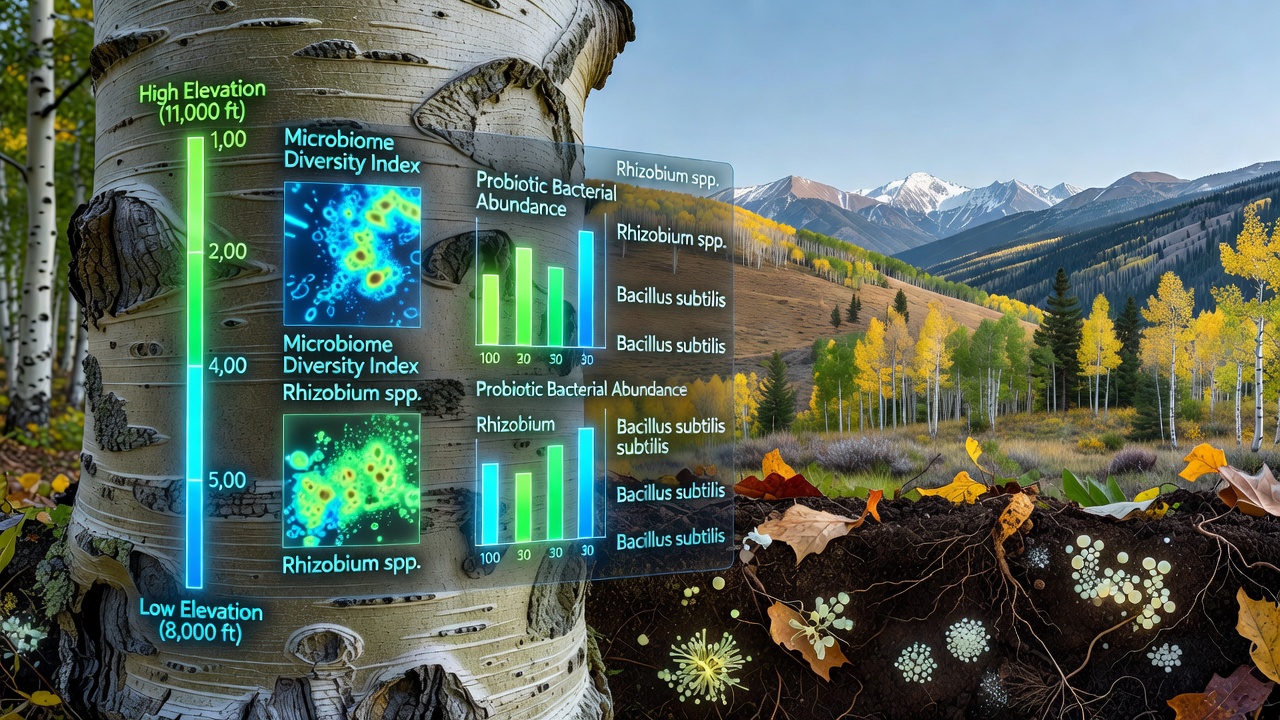
Application protocols developed by these groups specify that bark-derived inoculants should be applied as seed coatings or root dips before transplanting into amended soils, and timing coincides with snowmelt to maximize establishment. Data from 2025 trials in Wyoming and Montana indicate that matching the elevation origin of the microbial source to the target farm site produces the largest yield gains in barley and potato test crops, whereas mismatched inoculants show neutral or slightly negative effects. What's interesting is that functional assays reveal elevated expression of genes for siderophore production and phosphate solubilization in communities sourced from 2900-meter stands, traits that directly address common nutrient limitations at high altitudes.
Implementation Across Farming Cooperatives
Cooperative networks in the San Juan Mountains and the Carpathian highlands have integrated bark-microbiome profiling into their soil-management planning cycles. Technicians collect reference bark samples from nearby aspen groves each spring, sequence a subset, and use the resulting profiles to select or blend commercial probiotic products. Extension reports from these regions document that participating farms reduced synthetic fertilizer inputs by an average of 18 percent over two seasons while maintaining or increasing marketable yields. Soil cores taken one year after inoculation show elevated populations of the introduced taxa at depths of 10 to 30 centimeters, suggesting successful migration from surface applications into the root zone.
International exchanges between North American and Australian high-country producers have accelerated refinement of these methods, with Australian researchers contributing data on analogous eucalypt bark microbiomes that share some functional overlap with aspen communities. Government agricultural agencies in both countries now list elevation-specific microbial inoculants among recommended tools for climate-resilient farming above 2500 meters.
Conclusion
Continued sampling across additional mountain ranges will clarify how quickly bark microbiomes respond to changing climate normals, and cooperative-led trials will quantify long-term effects on soil carbon and crop resilience. The patterns already documented supply a practical template for tailoring probiotic amendments to the distinct conditions found at different elevations, and adoption by high-altitude farming groups continues to expand as protocols become more standardized.