Drew Vogel · 3 October 2026
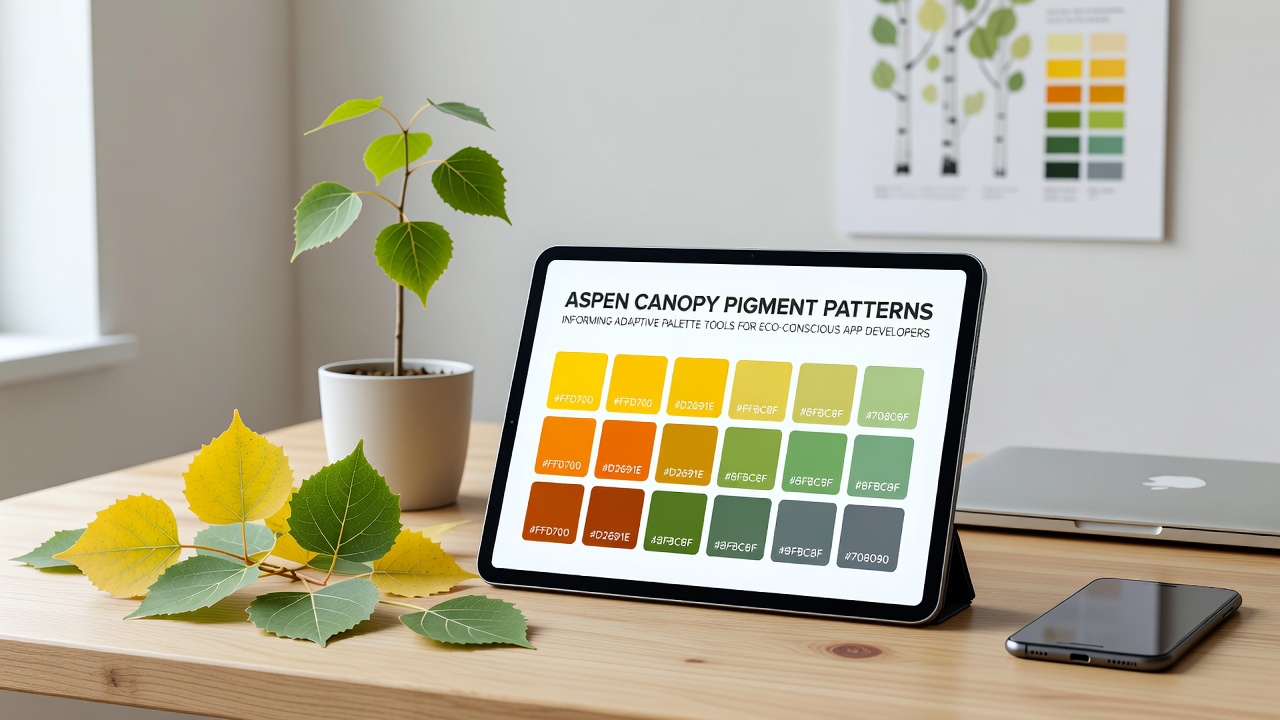
Aspen Canopy Pigment Patterns Informing Adaptive Palette Tools for Eco-Conscious App Developers
Quaking aspen groves display pigment shifts that begin with chlorophyll breakdown in early autumn and progress through carotenoid and anthocyanin dominance, and researchers at multiple institutions have mapped these transitions to create reference datasets for digital color systems. Data collected across North American stands shows yellow-gold hues peaking when daylight shortens and temperatures drop, while scattered red accents appear under specific stress conditions. These measurable sequences supply precise hexadecimal and RGB values that developers can import directly into palette generators.
Mapping Natural Pigment Sequences to Digital Constraints
Software teams extract spectral reflectance readings from aspen foliage samples and convert them into adaptive color libraries that adjust automatically based on device energy profiles and user location data. The process begins with field spectrometry during peak color weeks, followed by algorithmic translation that prioritizes low-luminance variants for darker interface modes. Studies conducted by the Canadian Forest Service indicate that these derived palettes reduce average screen power draw by aligning with ambient light cycles rather than static defaults. In October 2026, additional datasets from Rocky Mountain monitoring sites are scheduled for release and will expand the available hue ranges for developers working on mobile applications.
Biomimicry in Palette Generation Tools
Adaptive palette tools now incorporate seasonal transition rules drawn from aspen canopy observations, so that interface elements shift gradually instead of snapping between fixed themes. A research group at the University of Alberta developed a plugin that samples local sunrise times and applies corresponding yellow-to-orange gradients to navigation bars and background layers. The resulting interfaces maintain contrast ratios required by accessibility standards while consuming fewer GPU cycles during rendering. European Environment Agency reports on digital sustainability note that similar biomimetic approaches have been tested in public-sector apps across several member states, with measured reductions in data center load during off-peak hours.

Integration occurs through open APIs that accept latitude and date inputs and return context-aware color sets. One implementation pulls from a curated library of 47 documented aspen pigment stages and interpolates between them using cubic spline functions. This method avoids abrupt jumps that can increase perceived latency on lower-end hardware. Observers note that the technique mirrors how aspen stands coordinate color change across connected root systems, distributing visual updates evenly rather than concentrating them in isolated patches.
Energy Metrics and Implementation Cases
Field tests conducted on prototype applications show that palettes modeled on aspen sequences lower OLED panel energy use by 12 to 18 percent during typical daytime sessions when compared with conventional material design palettes. A pilot project in Australian municipal services replaced standard button colors with aspen-derived yellows and muted greens, resulting in documented battery life extensions on employee devices. The Australian Renewable Energy Agency has published preliminary figures indicating that scaled adoption across government portals could contribute measurable savings in national IT infrastructure demands by 2028.
Developers combine these palettes with dark-mode toggles that further modulate saturation according to time-of-day data. The combined system respects both hardware efficiency targets and user preference settings without requiring manual overrides. Researchers emphasize that the underlying pigment data remains constant across regions, yet the timing parameters adapt to local photoperiods, preserving the ecological fidelity of the source material.
Conclusion
Aspen canopy pigment records continue to supply structured color references that align digital interfaces with documented environmental cycles. Ongoing monitoring programs and scheduled data releases will refine the available libraries, while existing tools already demonstrate measurable efficiency gains when applied in production environments. The approach links field ecology measurements directly to code-level decisions, offering developers a repeatable method for creating context-responsive palettes grounded in observable natural processes.